

Cities & Mobility · 2031–2036
Cities in Motion: How Will We Live and Move in 2035?
Housing, transport and infrastructure shape the time and money we spend moving around. Explore the numbers and three paths towards more accessible cities in 2035.
3 min read · Published 2026-09-26 · Watch the full episode ↓
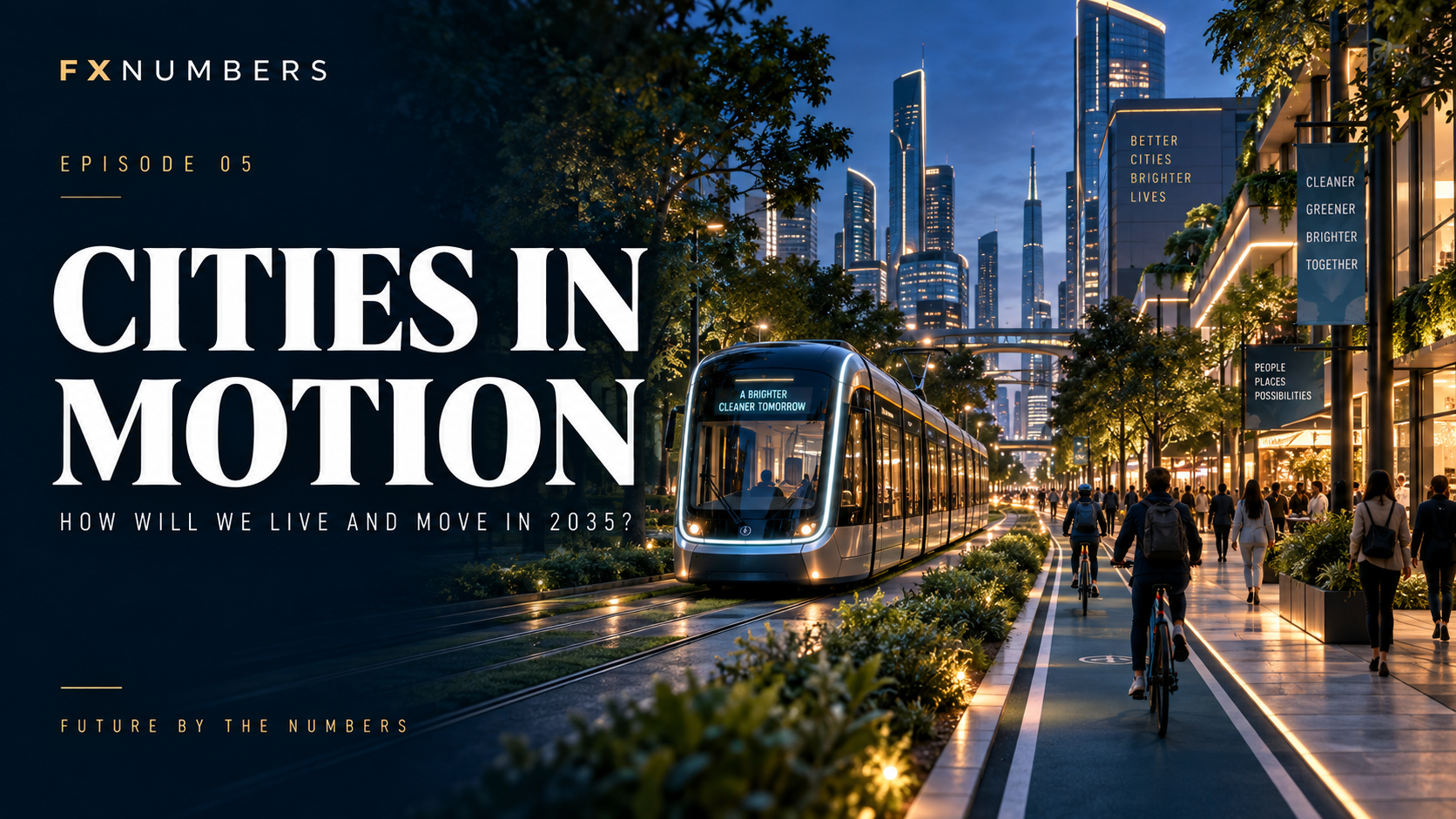
What makes a city easier to live in?
Picture a day in 2035: an appointment within walking distance, a dependable electric bus to the station and a collection point for deliveries nearby. The most useful change may be measured in time recovered and places reached.
Cities in Motion explores how housing, transport and infrastructure could work together over the next decade. Our central question is how more people can reach jobs and essential services without excessive cost or complicated journeys.
The numbers behind the transition
The World Bank's Atlas of Global Development describes about 4.7 billion people living in urban areas, roughly 58% of the world population. That broad measure includes different kinds of settlements, not only large metropolitan centres.
Electric vehicles are changing new purchases faster than the vehicles already on the road. The IEA reports more than 20 million electric car sales in 2025, around a quarter of new car sales. Electric cars include battery electric vehicles and plug-in hybrids. In the IEA's exploratory scenarios, their share of new car sales approaches 50% in 2035. That is a scenario for sales, not a claim that half of the entire fleet will be electric.
For operators, electrification means coordinating vehicles, chargers, electrical connections and staff. A bus depot succeeds when its fleet is ready for tomorrow's routes. Equipment alone does not deliver that result.
Fifteen minutes can become 100 hours
Suppose a transport improvement saves a commuter 15 minutes in each direction across 200 working days. The calculation is 30 minutes × 200 ÷ 60: 100 hours recovered each year.
This is an illustrative example, not a forecast for a particular city. It shows why reliability and access belong beside vehicle sales in any assessment of urban progress.
Housing changes the calculation too. A cheaper home far from work may bring higher travel costs and longer journeys. Connecting new homes to existing stations, shops and services can expand the choices available to residents.
Three paths to 2035
Fragmented upgrade: cleaner vehicles and better individual apps arrive, but housing and transport remain poorly connected. Some neighbourhoods improve while others face lengthy, expensive journeys. The opportunity is to connect existing services and extend their reach.
Connected city: our central scenario combines practical fleet electrification, dependable public transport, safer walking routes and housing near useful infrastructure. Progress appears as a wider set of everyday options.
Accelerated accessibility: planning, investment and operations reinforce one another across an urban region. Passenger services, freight, payment and information systems become easier to coordinate. More residents gain affordable access to work and essential services.
These are possible paths, not assigned probabilities. Automated shuttles and smaller delivery vehicles may contribute where local conditions suit them; neither replaces the need to plan the wider system.
What to watch
Track access to jobs and services, journey reliability, total household transport costs, useful charging capacity and the supply of well-connected housing. For businesses, opportunities could emerge in fleet operations, charging coordination, neighbourhood logistics and development around existing transport links.
The test is practical: can a parent get home sooner, an older resident travel independently and a shop receive its deliveries reliably? Watch the full episode below for the examples and reasoning behind these scenarios.
Sources
World Bank — Building Productive Cities for an Urbanizing World.
International Energy Agency — Global EV Outlook 2026, Executive summary.
Watch the full episode
Explore the examples and reasoning behind this article.
Listen to this article
AI narration. Translated editions are generated on request.
Browse all audio articles →